Showing posts with label glass profile. Show all posts

Tuesday, February 23, 2010

Glass Profile: Uroboros glass brand


My projects take long enough that a daily update isn't practical. For that reason, here is another fun tangential topic: Uroboros brand glass.

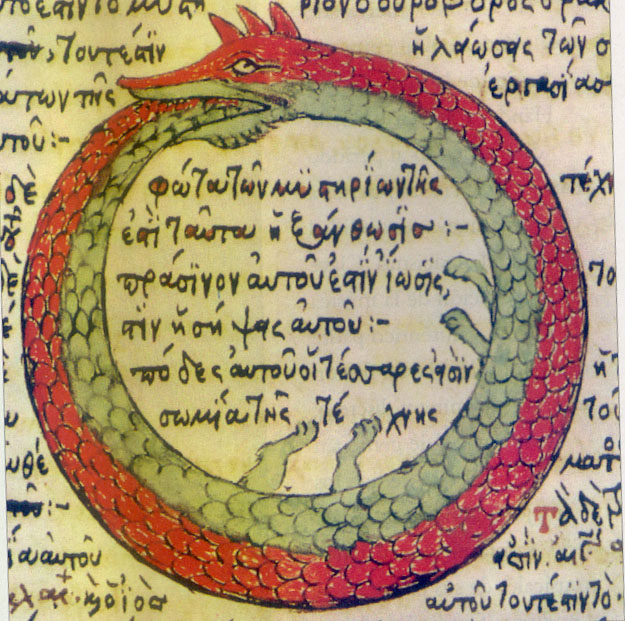
First, I have to give kudos for their company name. The uroboros is an ancient artistic motif, incorporating a serpent or dragon that circles around to bite its own tail. The motif can represent creation, the cyclical nature of time, or infinity. That's just cool.

According to Wikipedia:

"Plato described a self-eating, circular being as the first living thing in the universe—an immortal, perfectly constructed animal.

'The living being had no need of eyes when there was nothing remaining outside him to be seen; nor of ears when there was nothing to be heard; and there was no surrounding atmosphere to be breathed; nor would there have been any use of organs by the help of which he might receive his food or get rid of what he had already digested, since there was nothing which went from him or came into him: for there was nothing beside him. Of design he was created thus...'"
The uroboros symbol also appears in many modern media, including the Wheel of Time fantasy series by Robert Jordan.

The second thing going for the Uroboros glass company is that many high-end patterns recommend their glass for the pieces. The glass is particularly good for organic subject matter, which is what I'm most interested in making. Look at these samples of glass for sale on the Uroboros website:

Wednesday, February 17, 2010

Glass Profile: Silver Staining


A Bit of Art History


Silver staining is what gave rise to the term "stained glass." According to P.E. Michelli:
"Silver stain was fired onto clear glass to produce a translucent yellow - or any colour between murky brown and deep amber. It was discovered around the beginning of the fourteenth century, apparently in France, and was used sparingly at first, and then very creatively to produce local contrasts on coloured glass."

Granted, I'm no art historian. But if you examine older stained glass, you'll see that there are relatively few colors - red, yellow, blue and green. This parallels the paintings and illuminated text of that time. In the Medieval era, the artistic emphasis of stained glass was placed on the painting and staining of relatively simple glass shapes. These were religious icons, made in glass to resemble their painted predecessors as closely as possible.


Silver staining was apparently easier to use than a yellow glass. Also, for the purposes of fine detail, staining gives more flexibility; multiple coatings and firings of the silver stain can enhance the color. In this way, different hues from beige to gold can be achieved on the same piece of glass. Silver staining was also used to turn blue glass into green glass.

Today

Modern silver staining is less common but may still be used for traditional works. There is the occasional contemporary piece, like this close-up of a window by Williams and Byrne.


I would argue that today, while styles of stained glass are much more diverse, there is generally more use of shapes, colors and textures of the glass itself. I don't know that I'd use the silver stain technique. I could simply purchase yellow glass, or plate some yellow glass behind the main layer. Still, it's a fun bit of history!

Friday, February 12, 2010

Glass Profile: Tiffany @ the Smith Museum

I visited the Smith Museum in Chigaco several years ago. It was a fascinating experience even then, and I would certainly appreciate the museum a lot more now. Fortunately, much of the collection can be viewed online. The museum has a particularly large collection of Tiffany glass. Certain pieces evoke the peaceful contentment that I look for in all art, like this landscape window:


However, many pieces seem over the top, like this, um...transgender rainbow angel?